About Hochschule Fresenius
Hochschule Fresenius, with locations in Frankfurt am Main, Hamburg, Idstein, Cologne, Munich, and study centers in Berlin, Dusseldorf, and New York, is the largest private on-site university in Germany with over 18,000 students. The university offers a wide range of subjects in the fields of Chemistry & Biology, Design, Health & Social Sciences, onlineplus, as well as Business & Media, providing full-time Bachelor's and Master's programs, as well as part-time and dual study programs. Hochschule Fresenius is institutionally accredited by the German Council of Science and Humanities. In its initial accreditation in 2010, the German Council of Science and Humanities particularly appreciated its "wide and innovative range of Bachelor's and Master's programs," its "internationality," and its "convincingly designed practical relevance."
Teaching and Research with a Practical Focus: Mission & History
Hochschule Fresenius looks back on more than 168 years of tradition. In 1848, Carl Remigius Fresenius founded the "Chemical Laboratory Fresenius" in Wiesbaden, which from the beginning was dedicated to both practical laboratory work and education. Since 1971, the university has been state-recognized.
"To teach and research with a practical focus, live internationality, accompany, challenge, and promote students!" - this is the motto of Hochschule Fresenius.
Important historical dates of the university at a glance:
- 1848: Carl Remigius Fresenius founds the "Chemical Laboratory Fresenius" with an affiliated chemistry school in Wiesbaden
- 1908: Women are admitted to education for the first time
- 1931: The university achieves state recognition for training chemical technicians
- 1971: The university becomes state-recognized as a university of applied sciences under private sponsorship
- 1998: The departments of Business & Media and Health are founded
- 2003: The Cologne campus is opened
- 2008: The Hamburg and Munich campuses are opened
- 2012: The Dusseldorf and Frankfurt am Main campuses, as well as the liaison office in New York, are opened
- 2015: Distance learning programs are introduced. In addition, Hochschule Fresenius receives system accreditation
- 2017: The Hochschule Fresenius Heidelberg is opened
- 2019: The Wiesbaden campus is opened
10 Locations from Idstein to Berlin to New York
Hochschule Fresenius is represented at a total of 10 locations in Germany and the USA. Many degree programs are offered at multiple locations. Students can easily change locations during their studies and, for example, study a semester in Berlin and another semester in Cologne.
Overview of the locations:
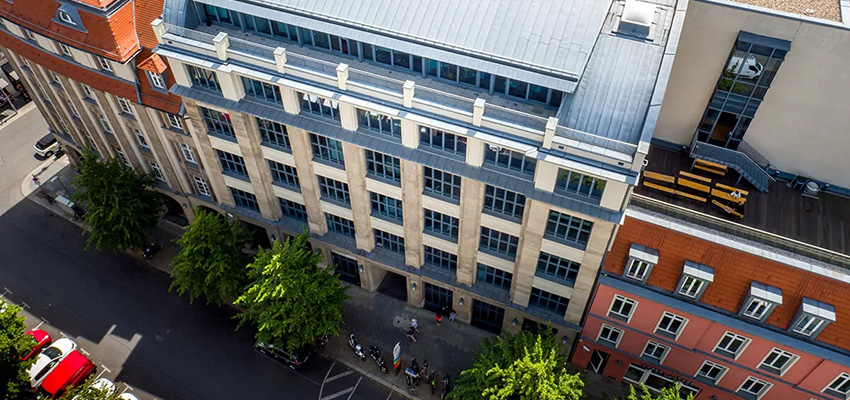
Berlin: In Berlin, Hochschule Fresenius operates a campus for the Business & Media department at Jägerstraße 32, in Berlin-Mitte directly at the Gendarmenmarkt. Another campus for the Fashion & Design department is located in Prenzlauer Berg. Berlin, as the federal capital and political center, is also an exciting university city - there are around 170,000 students in Berlin.
Idstein: Idstein is a small university town in the southern Hesse district of Rheingau-Taunus-Kreis, near the state capital Wiesbaden. Conveniently, the region in and around Idstein is home to numerous industries and companies - so the job prospects are excellent. Incidentally, Idstein is the headquarters of Hochschule Fresenius. The main building is located directly in the city center on Limburger Straße.
Frankfurt: Frankfurt am Main is a manageable city but at the same time has an interesting metropolitan character with international flair. In addition to banking and real estate, the city also offers a lively media landscape and a well-established healthcare industry. You can find the Health & Social Sciences department of Hochschule Fresenius in Marienburgstraße 6.
Wiesbaden: In Wiesbaden, as the state capital of Hesse, Hochschule Fresenius has its roots, as Carl Remigius Fresenius founded his Chemical Laboratory there in 1848. The city not only offers numerous historical sights but also an interesting corporate structure with many medium-sized companies, service providers, agencies, and a lively start-up scene. Hochschule Fresenius, with its 30 modern lecture halls, university library, and canteen, is located at Moritzstr. 17a.
Dusseldorf: Dusseldorf is an important economic hub for advertising, telecommunications, fashion, and management consulting. Due to the diverse mix of industries based in Dusseldorf, the city is excellent for a top career start after graduation. You can find Hochschule Fresenius in Dusseldorf at 3 locations, at Platz der Ideen, Fährstraße, and Karl-Friedrich-Klees-Straße.
Heidelberg: Heidelberg, the beautiful city on the Neckar, you probably won't want to leave after completing your studies at Hochschule Fresenius. In addition to all the cultural possibilities, numerous research institutions, publicly traded companies, and medium-sized global market leaders are located in the region - so the job prospects are excellent. You can find Hochschule Fresenius Heidelberg at Sickingenstraße 63-65, right near the Campbell Barracks conversion area.
Hamburg: Hamburg, one of the most attractive cities in Germany, not only offers a wide range of cultural activities and countless opportunities for going out. The professional prospects for the time after the studies in Hamburg are excellent: Logistics and trade are interesting industries, numerous advertising agencies and publishers are located there, and the healthcare sector thrives in the city of 1.7 million. The Business & Media campus of Hochschule Fresenius is located in Alte Rabenstraße, and the Health & Social Sciences campus is located in Lilienstraße in Hamburg.
Cologne: Cologne, the vibrant city of 1.1 million in North Rhine-Westphalia, not only offers plenty of culture and entertainment. The city is also one of the most important economic centers in Germany. Especially media companies, insurance, food, and chemical companies are located there - so the chances of starting a career in Cologne after studying are particularly high. You can find the Business & Media and Health & Social Sciences campuses of Hochschule Fresenius directly at the MediaPark, the business park for media companies in the Neustadt-Nord district of Cologne.
Munich: Munich is one of the cities with the highest quality of life in Germany. The Bavarian capital not only offers an enormous cultural offer and many sights but also a beautiful surrounding area with numerous lakes. With many well-known internationally active companies, Munich is one of the economically strongest cities in Germany. Hochschule Fresenius is represented in Munich with two campuses: The Business & Media campus is located in Schwabing on Infanteriestraße, and the Health & Social Sciences campus is on Charles-de-Gaulle-Straße.
Natural Sciences, Health, Business: The 5 Departments of Hochschule Fresenius
Hochschule Fresenius offers its 100+ degree programs in a total of 5 departments.
Chemistry & Biology: The Chemistry & Biology department is the oldest and most traditional department of the university. Its roots date back to 1848 when Carl Remigius Fresenius founded the "Chemical Laboratory Fresenius" in Wiesbaden. Popular programs in the department include the B.Sc. Applied Chemistry for Analytics, Forensics, and Life Science and the M.Sc. Business Chemistry.
Design: In the Design department, Hochschule Fresenius has been training students for creative and business-oriented professions in the creative industry since 2013 under the name AMD Akademie Mode & Design. The AMD itself has existed since 1989. Popular programs in the department include the B.A. Fashion Design.
Health & Social Sciences: The Health & Social Sciences department trains the specialists and leaders of the healthcare industry of tomorrow. Part of the department are the further education offers and degree programs of the Carl Remigius Medical School. Popular programs in the department: The B.Sc. Physician Assistance and the B.A. Social Work.
Business & Media: Practice orientation, internationality, and the extensive partner network at the respective locations are core features of the Business & Media department. Hochschule Fresenius cooperates with numerous renowned companies that provide topics for projects and thesis papers as well as internship positions. Popular programs in the department: The B.A. Business Administration and the MBA General Management.
Online Plus: The Online Plus department offers the distance learning programs of Hochschule Fresenius. Characteristic of this department are flexibility and interdisciplinary. The university now offers 25 study programs and numerous further education programs through this department. Popular distance learning programs in the department: The B.Sc. Psychology and the M.A. Media and Communication Management.
Experiences & Reviews
Reviews you can rely on Share your experience with this university - for nothing in return. For more transparency and better decisions.
👉 Rate honestly nowThe Hochschule Fresenius receives a mixed, but predominantly positive feedback from its students. Many students appreciate the practical study content and the high quality of teaching. Numerous testimonials highlight small class sizes that create a personal learning atmosphere. Lecturers often bring extensive practical experience and integrate it into their teaching, making lectures lively and vivid. Guest lectures from companies, project work, and a close connection to the professional world are often part of everyday life at Fresenius. This combination of theory and practice is seen as a helpful preparation for entering the workforce. Overall, students feel well supported in their field of study and have the sense of studying something "meaningful" for their career. Particularly in business-related fields, many report good job prospects and valuable industry contacts even during their studies.
The teaching and support are largely positively evaluated. Students praise the dedicated teaching staff, who are approachable in most cases and take time to answer individual questions. The experience reports mention that emails and student inquiries are often answered promptly and helpfully. Due to the manageable group sizes, educators can better cater to the needs of individual students, which many see as a major plus. Some degree programmes – especially in the natural and health sciences – are described in the reports as having very good support: for instance, lab experiments are well-organized, and each student gets a place without competition. Such structured processes relieve students of much pressure and create a sense of security in their studies. However, some testimonials also point out that the quality of instructors is not consistent everywhere. There were isolated criticisms of lecturers who seemed less motivated or less competent, or in some cases, were difficult to reach – especially at certain locations or in specific subjects. Nevertheless, the overall impression is that the instructors are competent and care for their students.
A frequently recurring point of criticism concerns the organization of the university. Several students criticize coordination issues and administrative processes. For example, it is reported that schedules and room assignments are sometimes changed at short notice or classes are canceled due to missing lecturers. Examination management is also criticized: organizational weaknesses such as long waiting times for grades and approvals or registration for exams without available information have been described. Some students felt misled in advance by the university's marketing promises of "comprehensive care," but then experienced gaps in study organization. On a positive note, the university reacted quickly to the COVID-19 pandemic – the lecture operation was swiftly transitioned to digital formats without loss of teaching content, and as soon as possible, students were able to return to in-person classes. However, some reviews negatively noted that increased online teaching was maintained in some degree programmes. Satisfaction with the organization seems to depend heavily on the location and programme: while some report smooth processes and good planning, others at less organized locations feel abandoned and have to show a lot of self-initiative.
The campus facilities and infrastructure of Hochschule Fresenius are rated very differently and are also strongly location-dependent. At established locations – such as the main campus in Cologne – students describe the facilities as modern and functional. Apparently, there are attractive seminar rooms for small groups, places to study, and even lounge areas to relax between courses. A master's student, for example, talks about "very modern equipment" and a pleasant study environment. In contrast, reports from smaller or newer locations are much more critical. For example, it is reported for Frankfurt am Main that the university there does not own a building, but only uses rooms in a university hospital – with a single hallway as the campus area. Consequently, essential facilities are missing at such places: no cafeteria or cafe, no library on-site, which significantly diminishes the atmosphere and the sense of well-being. Some students at the Frankfurt location felt unwelcome and had little reason to linger longer at the "campus." The lack of a proper university library is a recurring theme in negative reviews. Often, students need to use literature and study spaces at neighboring state universities because Fresenius offers a very limited selection of books or study spaces on-site. The technical equipment also varies: Some criticize outdated presentation technology (such as projectors with only VGA connectors) and simple furniture, which is considered inadequate given the high tuition fees. On the other hand, other students praise the digital infrastructure – such as the learning platform and online resources – and highlight that WLAN and IT services mostly function reliably. Overall, larger locations seem to be much better equipped, while smaller locations are in need of catch-up. This difference can lead to students at the same university having very different experiences with the infrastructure.
Regarding student life and networking outside of classes, Hochschule Fresenius is regarded as somewhat below average in the eyes of many students. Due to its structure as a private university with distributed locations, there is less of the traditional campus culture found at large state universities. Several testimonials mention that student events or parties hardly ever take place. While some students were aware of a student council (AStA), they saw little of it in daily life – AStA rooms were never occupied, and activities were practically nonexistent. Those looking for a lively campus with a lot of student activity may be rather disappointed at many Fresenius locations. However, the small class sizes at least foster camaraderie among peers: many students describe their classroom atmosphere as friendly and closely connected. They get to know their fellow students well and often form study groups or networks on a small scale. In this sense, a personal community is formed, even though major university festivals or traditional university sports and cultural offerings are missing. In terms of networking for careers, Fresenius offers advantages: through the aforementioned collaborations with companies and the existing alumni network (emphasized by the university), students have opportunities to make contacts in the professional world. Mandatory internships, project work with industry partners, and instructors from the industry ensure that meaningful relationships can be formed during studies. Thus, while the classic student life is less pronounced, many students at Fresenius feel well supported in terms of professional networking.
In the realm of careers and practical relevance, Hochschule Fresenius enjoys a good reputation among its students. Practical orientation and relevance to the professional world are key aspects of many degree programmes. Students positively highlight that they acquire practical skills and insights into current industry developments. Projects, case studies, and internships prepare them concretely for their jobs. Some testimonials compare the requirements to public universities: indeed, studying at Fresenius is sometimes described as slightly easier or less theoretical. While for some, this may mean that the academic depth is lower, many students see it as an advantage that the focus is on applied learning. The career prospects are generally viewed optimistically. Students appreciate that the university opens doors to companies for them – be it through networking events, career services, or recommendations from industry-experienced instructors. However, there are also cautionary voices. Particularly in psychology studies, it was reported that certain career paths (e.g., licensure as a psychotherapist) were not possible with a Fresenius degree. Additionally, some note that private education is still stigmatized in parts of the public, although these experiences seem to be exceptions, mostly from very traditional fields. In most industries – especially business, media, health, or design – Fresenius graduates feel well-equipped and competitive. Overall, the prevailing impression on this topic is that the university equips students with practical skills and contacts that can facilitate the transition into professional life.
Finally, the relationship between price and performance is repeatedly discussed, as it is a private university and therefore a fee-paying institution. Depending on the programme and model, the tuition fees average several hundred euros per month (often around 700–800€ monthly). Many students emphasize that they were aware they were paying a high price for their education and therefore had high expectations of the university. Opinions differ on whether these expectations were met. Those who could fully benefit from the advantages described above express positive views: personal support, practical learning, small groups, and a chance to study despite Numerus Clausus restrictions elsewhere. They see the costs as an investment that is worthwhile because they feel well-supported at Fresenius and may not have had a comparable alternative at a state university. Some mention transparent fee models, sibling discounts, or flexible part-time and distance learning options that somewhat relativize the high price. On the other hand, students with experiences where quality and organization fell short of expectations are critical. If, for example, the facilities are inadequate or the organization is chaotic, the price-performance ratio is seriously questioned. Negative reviews show that satisfaction with the price-performance greatly depends on whether the promised quality is actually delivered. In summary, Hochschule Fresenius falls into the middle range in this category: while the majority of students agree that the study is expensive, they perceive the education and support offered as at least largely adequate – especially in comparison with other private providers. Nonetheless, for some, the impression remains that more should be delivered for the price, especially in terms of facilities and organization.
Overall, Hochschule Fresenius convinces students through its practice-oriented study content, personal support in small groups, and instructors with high professional expertise. Particularly in business-related and health-related programmes, students benefit from good career connections and a high practical relevance. At the same time, weaknesses in the organizational structure and facilities – especially at smaller or newer locations – can negatively impact the price-performance ratio. Outside of classes, student life at many locations is only weakly developed. Overall, the university is particularly suitable for those seeking a goal-oriented study with a strong practical focus, while the classic university atmosphere or research-intensive approaches are less in focus. Despite existing criticisms, positive impressions prevail in the reviews, especially concerning career opportunities and the individual learning environment.
Disclaimer: This editorial evaluation is based on an analysis of publicly available reviews, testimonials, and opinions from various sources. The summary provides an objective and factual representation of the most common positive and negative aspects as reported by current and former students. It does not claim to be complete or absolutely correct. Individual experiences may vary, and it is recommended to seek additional information independently before making a study decision.
English
Deutsch


Advisory Service
Questions for the private university Fresenius University of Applied Sciences? Ask your question here, even anonymously. An employee of the university or the editorial team will answer you.
or post as a guest