Who can apply for the Medical and Pharmaceutical Biotechnology Master at Fresenius?
You need a Bachelor's degree with at least 180 ECTS in a chemistry- or biology-related field — pharmacy, chemistry, biology, biochemistry, biotechnology or a comparable subject. Plus documented prior knowledge in organic chemistry and biochemistry, typically through completed undergraduate modules. The programme is taught in English at B2 level, so an English language certificate is mandatory unless your prior education was English-medium.
This Master is built for graduates of life science Bachelors who want to specialise in the biopharmaceutical industry — whether moving towards research and development, regulatory affairs, GMP-compliant manufacturing or bioprocess engineering. The programme assumes a strong scientific foundation; it is not an interdisciplinary entry route into biotechnology.
Formal admission requirements
- Bachelor's degree (180 ECTS minimum) in a chemistry- or biology-related discipline — pharmacy, chemistry, biology, biochemistry, biotechnology, or comparable.
- Subject-specific prior knowledge: documented modules in organic chemistry and biochemistry. The admissions team reviews transcripts to confirm the foundation is sufficient.
- English language proof at B2 level (CEFR): typically IELTS 5.5, TOEFL iBT 72, or comparable. Native speakers and graduates from English-medium institutions are exempt.
- Recognition of foreign credentials: Bachelor's degrees from outside Germany are reviewed against German equivalence standards. The German conference of cultural ministers' database (in German: anabin, anabin.kmk.org) classifies most national diplomas — applicants from countries not pre-classified are reviewed individually.
- No GRE, no entrance exam. Admission is decided based on transcripts and language proof; in some cases an interview is added.
What you should bring personally
This is a hands-on Master with three mandatory laboratory internships and a heavy GMP and regulatory component. The students who finish on time and move smoothly into industry typically share a few traits — none of them tested at admission, but all of them strongly correlated with success:
- Solid laboratory practice from your Bachelor — the programme assumes you're comfortable in a lab setting and can work safely with biological and chemical samples
- Comfort with regulatory and quality-system thinking — modules in GMP, regulatory affairs and quality control are central, not peripheral
- Quantitative and analytical mindset — bioanalysis, data science modules and bioprocess simulation reward applicants with maths and statistics fluency
- Project-management orientation — modules and laboratory internships are structured around scientific project work mirroring industrial reality
- Clear industry orientation — this is an applied Master aimed at the biopharmaceutical industry, not a research-only academic Master leading directly to a PhD (though a PhD path is possible)
Who this programme is built for
Three profiles fit the Fresenius Medical and Pharmaceutical Biotechnology Master particularly well:
- International life science Bachelor graduates — typically from Asia, the Middle East or Latin America with a Pharma, Chemistry or Biology background, looking for an English-taught applied Master in Germany with strong industry connections
- European Bachelor graduates moving into the biopharmaceutical industry — particularly those targeting the German pharma corridor (Frankfurt/Rhine-Main, Heidelberg, Mainz) where Boehringer Ingelheim, Sanofi, Merck KGaA, BioNTech and Fresenius itself are headquartered
- Career changers within life sciences — Bachelor graduates currently working in adjacent fields who want to specialise in pharmaceutical biotechnology, regulatory affairs or GMP-compliant manufacturing
Note on language and format: This Master is taught entirely in English as a full-time campus programme at the Fresenius Idstein location near Frankfurt — the largest Hochschule Fresenius campus and the home of its life science programmes. There is no distance learning or part-time variant of this programme.
What will you study in the Medical and Pharmaceutical Biotechnology Master?
The Master covers 120 ECTS across four semesters, structured around the full biopharmaceutical value chain. The curriculum moves systematically from molecular foundations to industrial-scale production, embedding regulatory and quality systems throughout — the way the biopharmaceutical industry actually operates.
Molecular and bioanalytical foundations
The programme starts with the scientific core: (bio)molecular sciences, biotechnological methods, and bioanalytical techniques for analysing biopharmaceuticals and their excipients. This is where Bachelor knowledge in organic chemistry and biochemistry gets translated into specific pharmaceutical applications — protein structure analysis, antibody characterisation, mass spectrometry workflows.
Bioprocess engineering and industrial processes
The middle of the programme builds the engineering layer: principles of biopharmaceutical process engineering, plant engineering, upstream processing (cell culture, fermentation), bioseparation techniques and downstream processing for the production of medical and biopharmaceutical products. You learn to design, visualise and simulate pharmaceutical processes — competencies that map directly onto manufacturing roles in the industry.
GMP, regulatory affairs and quality systems
Running through every semester: Good Manufacturing Practice (GMP) and the regulatory frameworks that govern biopharmaceutical production. Modules cover GMP-related topics, regulatory affairs across the biopharmaceutical value chain, quality control, and the application of regulatory knowledge to industrial workflows. This is the part of the curriculum that distinguishes Fresenius's applied approach from purely academic biotechnology Masters.
Data science, project management and management methods
The final layer adds data science, project management with a focus on the medical and biopharmaceutical industry, and modern management methods applied to specific industrial problems. These modules are aimed at the industry reality where biotechnology specialists are increasingly expected to manage cross-functional projects and handle large, structured datasets.
Three mandatory laboratory internships
The differentiator: across the four semesters, you complete three laboratory internships that apply your knowledge to industry-style scientific projects. These aren't optional add-ons — they're structurally integrated into the curriculum, mirroring how research and development happens in the biopharmaceutical industry. Together with the Master thesis, they form the practical backbone of the programme.
Master thesis
The fourth semester is dedicated to the Master thesis — typically conducted in collaboration with an industry partner or research institution, on an applied biopharmaceutical topic. Theses with empirical laboratory work are common, as are projects in industrial settings (Boehringer Ingelheim, Sanofi, Merck KGaA, BioNTech and other pharma companies in the Rhine-Main region regularly host Fresenius Master students).
How does studying at the Idstein campus work?
This is a full-time on-campus programme: scheduled lectures, seminars and laboratory sessions on the Idstein campus, supplemented by independent study and project work. Unlike distance learning programmes elsewhere on this site, attendance is the default and the laboratory internships require physical presence.
Idstein: Fresenius's life science campus
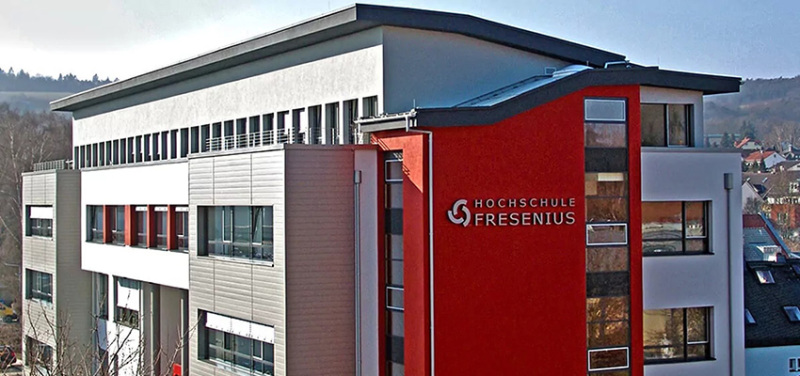
The Idstein campus is Hochschule Fresenius's largest location and the historical home of its chemistry and life science programmes. It houses the laboratory infrastructure required for the biotechnology Master — cell culture facilities, fermentation equipment, bioanalytical instrumentation. Idstein is a small university town of around 25,000 people, 30 kilometres west of Frankfurt and well connected by regional rail.
International student community
This Master is one of Fresenius's most internationally oriented programmes — the English-language curriculum and applied industry focus attract a high share of international students from Asia, the Middle East and Europe. Career Services and the International Office support the relocation, visa and integration process specifically for the international cohort.
Class format and assessment
Modules are taught through a mix of lectures, interactive seminars, laboratory work and project-based assessments. Examination formats vary by module — written exams for theoretical content, project reports and laboratory protocols for practical modules, and individual or group presentations for management and regulatory modules.
What does the Master cost — and how can you finance it?
Fresenius University of Applied Sciences charges tuition fees for its Master's programmes, communicated individually during the application process. Compared to a Master's at a UK university for international students (typically €25,000+ per year) or at a US private university (US$50,000+ per year), Fresenius programmes are substantially below UK and US international rates. The exact tuition for the Medical and Pharmaceutical Biotechnology Master is detailed in the info brochure on Fresenius's website.
One-time and additional costs
- Application fee: typically applies — confirmed during the application process
- Examination and graduation fees: covered within tuition
- Laboratory and materials: standard laboratory equipment and consumables are provided; specialised personal lab gear may be at student's cost
- Living costs in Idstein: approximately €900 to €1,200 per month for accommodation, food, transport and personal expenses — significantly lower than Frankfurt city itself
- Health insurance: mandatory for all students; public insurance (in German: gesetzliche Krankenversicherung) costs approximately €120 per month for students under 30
- Semester ticket: covers regional public transport across the Rhine-Main area, included in the semester contribution
Financing options for international students
- DAAD scholarships (the German Academic Exchange Service) — the primary scholarship route for international Master's students in Germany, with multiple programmes covering biotechnology and life sciences
- Fresenius scholarships — partial tuition reductions for selected applicants; the current scholarship programme is published on Fresenius's website each application cycle
- Education loans from your home country — Prodigy Finance and similar international student lenders offer loans specifically for Master's programmes in Germany
- Industry sponsorships — biopharmaceutical companies in the Rhine-Main corridor occasionally sponsor international Master's students with internship-to-employment pathways
- Werkstudent / part-time work — non-EU students on a student residence permit may work up to 20 hours per week, useful for covering living costs in Idstein
Living in Idstein: costs, life and language
Idstein is a small historic town in the Taunus hills, with around 25,000 inhabitants and a clearly student-influenced atmosphere thanks to the Fresenius campus. The town centre is medieval, the surrounding region is wooded and walkable, and the cost of living sits at the lower end of the German urban range.
Cost of living range
- Accommodation: €350 to €600 for a room in a shared flat (in German: Wohngemeinschaft, WG); €500 to €800 for a small studio
- Food and groceries: €250 to €350 per month if you cook at home, more if you eat out frequently
- Public transport: covered by the semester ticket — regional rail to Frankfurt takes around 35 to 40 minutes
- Health insurance and personal expenses: approximately €150 to €250 per month combined
Connectivity
Idstein sits on the Frankfurt regional rail network — Frankfurt main station is 35 to 40 minutes away, and Frankfurt Airport (one of Europe's largest international hubs) is around 50 minutes by direct train. This makes the location practical for international students arriving from anywhere in the world and for industry visits during studies.
English-friendly daily life
Idstein is a small German town — much daily life happens in German. Within the Fresenius campus and student community, English is widely spoken; in supermarkets, administrative offices and local services, basic German helps significantly. Frankfurt itself is highly English-friendly. Many international students at Fresenius take German language courses alongside their Master to build daily-life fluency and prepare for the German job market.
Visa, residence permit and what to do before you arrive
For non-EU students, a student visa is required for entry to Germany. The full visa-and-residence process for full-time campus Masters is:
- Apply for a student visa at the German embassy or consulate in your home country at least 3 months before the programme starts. The application requires the Fresenius admission letter, financial proof and health insurance.
- Financial proof — the blocked account (in German: Sperrkonto): currently around €11,904 per year as evidence that you can finance your stay. The amount is updated periodically by the German Federal Foreign Office.
- Health insurance: mandatory for visa issuance and enrolment. Public health insurance is the default for students under 30.
- After arrival: register your address (in German: Anmeldung) at the local registry office within 14 days, and apply for a residence permit at the local foreigners' authority (in German: Ausländerbehörde) within 90 days.
- Key sources: the German Federal Foreign Office (auswaertiges-amt.de), the local Idstein foreigners' authority, and the DAAD's information portal for international students
EU and EEA students don't need a visa — registration with the local registry office within 14 days of arrival is sufficient.
Is the Fresenius Master degree recognised internationally?
Yes — Hochschule Fresenius holds institutional accreditation by the German Council of Science and Humanities (in German: Wissenschaftsrat), the highest German quality benchmark for private universities. The Medical and Pharmaceutical Biotechnology Master is state-recognised and accredited by an independent accreditation agency (typically FIBAA for life science programmes — confirmed in the current programme documentation).
What this means for your home country
- USA and Canada: evaluation through WES (World Education Services) — Fresenius's institutional accreditation typically translates to a recognised Master's equivalent
- UK: ECTS-to-UK-credit conversion is accepted by most universities for further study and PhD admission
- Asia and the Middle East: recognition varies by country — check your home Ministry of Education's database. The institutional accreditation by the Wissenschaftsrat is the credential most authorities look for
- European pharmaceutical industry: the degree is widely recognised across European biopharmaceutical employers, with particularly strong recognition in the German Rhine-Main pharma corridor
Pathway to a PhD
The Master qualifies graduates for PhD admission in pharmaceutical sciences, biochemistry and biotechnology — typically in cooperation with a state university (since most Universities of Applied Sciences in Germany don't have full PhD-awarding rights). Fresenius cooperates with PhD partners in Germany and internationally; specific cooperation partners are confirmed during the Master programme.
Career options after the Medical and Pharmaceutical Biotechnology Master
The biopharmaceutical industry is one of the fastest-growing pharmaceutical sectors globally, driven by mRNA vaccines, antibody therapies and biologics for cancer, diabetes and autoimmune diseases. Germany hosts one of Europe's largest pharma corridors in the Rhine-Main region, with employers including BioNTech, Sanofi, Merck KGaA, Boehringer Ingelheim, Fresenius Kabi, Sartorius and Roche. Typical entry-level positions include:
- R&D Scientist in biopharmaceutical research and development teams
- Bioprocess Engineer in upstream and downstream processing
- Bioanalysis Specialist in quality control and analytical development
- Quality Control Analyst in GMP-compliant manufacturing environments
- Regulatory Affairs Specialist — managing submissions to EMA, FDA and other regulatory bodies
- Product or Process Manager in biopharmaceutical operations
- Bioprocess Consultant for engineering and consulting firms serving the pharma industry
Entry-level salaries for biotechnology Master graduates in the German pharmaceutical industry typically range between €48,000 and €58,000 gross per year, with the upper end common at large pharma companies in the Rhine-Main corridor. After 3 to 5 years in specialist roles, salaries reach €65,000 to €85,000, with senior R&D and regulatory affairs positions above €90,000. Outside Germany, salary ranges depend heavily on country and sector.
If you plan to stay in Germany after graduation
Non-EU graduates of accredited German Master's degrees automatically qualify for an 18-month residence permit for job search after completing the programme. Once you secure a qualifying job, the Blue Card route opens (currently around €43,800 minimum gross salary for shortage occupations — biotechnology and pharmaceutical roles often qualify). The German pharmaceutical industry is actively recruiting international Master graduates, particularly those with English fluency and applied laboratory training.
For whom is the Fresenius Biotechnology Master right — and for whom not?
This is a focused, applied Master with a clear industry orientation. It works well for specific applicant profiles and clearly less well for others — here's where the line runs:
The Fresenius Medical and Pharmaceutical Biotechnology Master is the right choice if you …
- … hold a Bachelor in Pharma, Chemistry, Biology, Biochemistry or Biotechnology with at least 180 ECTS and want to specialise in biopharmaceutical applications
- … want a fully English-taught Master at a German university with strong industry orientation
- … are aiming at industry roles in research, manufacturing, regulatory affairs, quality control or bioprocess engineering
- … want a hands-on programme with three structured laboratory internships rather than a theory-only Master
- … plan to relocate to Germany for studies and (potentially) for a career in the biopharmaceutical industry
- … are open to studying at a small-town campus within commuting distance of Frankfurt rather than in a major metropolitan area
The programme is less suitable if you …
- … don't have a chemistry or biology Bachelor with the required organic chemistry and biochemistry foundation — the curriculum builds on this and won't catch up gaps
- … are looking for a distance learning Master — this is a full-time campus programme, not a flexible online format
- … want a research-only Master with strong publication output and direct PhD pipeline at a research university — Fresenius is application-oriented, with a teaching focus
- … are aiming at medical (clinical) practice — this Master qualifies for industry and laboratory roles, not for clinical professions like medicine or pharmacy practice
- … cannot demonstrate at least English at B2 level (CEFR) — the language requirement is non-negotiable
- … expect a large urban campus experience with metropolitan amenities — Idstein is a small town, with daily commute or local life as the routine
Frequently asked questions about the Fresenius Biotechnology Master
Yes. All modules, exams and the Master thesis are in English. You'll need an English language certificate at B2 level (CEFR) — typically IELTS 5.5 or TOEFL iBT 72 — unless your prior education was at an English-medium institution.
Possibly. The formal requirement is a Bachelor in chemistry, biology, biochemistry, biotechnology or pharmacy with documented organic chemistry and biochemistry modules. Adjacent fields are reviewed individually — Fresenius's admissions team assesses transcripts case by case before formal application.
Yes, if you're a non-EU citizen. EU and EEA students don't need a visa — only an address registration after arrival. Non-EU students apply for the student visa at the German embassy in their home country at least 3 months before programme start, with proof of admission, financial means (currently €11,904 per year via a blocked account) and health insurance.
Yes. The Idstein campus is the historical home of Fresenius's chemistry and life science programmes and houses the laboratory infrastructure required for the biotechnology Master, including cell culture, fermentation and bioanalytical equipment.
Yes. The Master qualifies graduates for PhD admission in pharmaceutical sciences, biochemistry and biotechnology, typically in cooperation with state universities (since most Universities of Applied Sciences in Germany don't have full PhD-awarding rights). Fresenius cooperates with PhD partners in Germany and internationally.
Not for the Master itself — it's fully English-taught. For working in Germany after graduation, German varies by employer. Major pharma companies in the Rhine-Main corridor often operate in English at scientific and management level, but daily-life integration and many specialist roles benefit from German at B1 or B2 level. Many international Fresenius students take German language courses alongside their Master.
The three laboratory internships are part of the curriculum, not paid employment. If you complete them at an industry partner (which is possible and common), the partner may offer compensation — but it's not standardised across the programme.
Advisory Service
Have questions about Academic Programs Medical and Pharmaceutical Biotechnology? Ask your question here, even anonymously. An employee of the institution Fresenius University of Applied Sciences or the editorial team will answer you.