
 DE
DE Inhalt
There are currently only a handful of study programmes in entrepreneurship at private universities, especially Master's programmes, but also two Bachelor's programmes. I will present all the degree programmes in detail here and compare them in terms of admission requirements, tuition fees and study content. In addition, I will show you what distance learning or online study programmes in entrepreneurship are available.
Overview of all Courses
We have a total of 24 courses in the field of Entrepreneurship.

- Distance learning program
- Bachelor of Arts (B.A.)
- 6 Semester
- online
- German or English
- International Marketing, Introduction to Academic Work, Introduction to User Research, Project: Development of Business Ideas, Business 10, International Contract Management, Start-Up Financing, Accou…
In the Bachelor's degree programme Entrepreneurship, students learn how to develop and implement innovative ideas and business models. They acquire a broad knowledge of business administration as well as special knowledge in the area of start-up management and corporate governance. The focus is on practical experience and the promotion of entrepreneurial skills such as creativity, risk-taking and network building. Graduates are thus ideally equipped for a career as a founder, in business development or in the management of start-ups and established companies.
- Distance learning program
- Master of Arts (M.A.)
- 4 Semester
- online
- English
- Innovation and Entrepreneurial Ecosystems, Entre- and Intrapreneurship, Strategic Management, Business Model Design, Product Development, Advanced Research Methods, Applied Marketing Research, Sales a…
The Innovation and Entrepreneurship master's program at IU is designed to prepare students for careers in business creation and innovative business models. The program provides students with both theoretical and practical knowledge and skills in business planning, innovation management, market research, financing, risk management, and business creation. There are also opportunities for projects in collaboration with companies and startups, as well as internships to give students a practical understanding of how to apply their knowledge in the real world.
- Distance learning program
- Master of Arts (M.A.)
- 2 Semester
- online
- English
- Advanced Growth Hacking, Business Model Design, Lean Start Up, Project: Growth Hacking Tools, Applied Research, Seminar: Current Topics of Innovation and Entrepreneurship, Project: Growth Hack Develop…
The master's program "Growth Hacking for Entrepreneurs" at IU International University provides students with comprehensive knowledge and practical skills in the area of developing growth strategies for startups and companies. The focus is on applying data-driven methods and agile processes to identify and optimize growth potential. Students learn how to achieve rapid and sustainable growth for their companies through targeted testing and experimentation with new marketing and sales approaches. The course is suitable for aspiring entrepreneurs and for professionals who are already working in a company and want to expand their knowledge in the field of growth management.
- Distance learning program
- Master of Arts (M.A.)
- 2 Semester
- online
- German
- Digital Business Management, Digital Business Models, Lean Start Up, Innovation and Entrepreneurship, Applied Research, Project: Entrepreneurship-oriented Organizational Development, Seminar: New Work…
The Master's program "Digital Entrepreneurship" at IU is a distance learning program tailored to the needs of entrepreneurs and start-ups in the digital environment. The focus is on key aspects of entrepreneurship such as business planning, financing, marketing, technology, innovation, and project management. Students learn how to develop innovative business ideas and successfully implement them in practice. The curriculum is practical and includes case studies, project work, and simulations to prepare students for a career as successful digital entrepreneurs.

- Distance learning program
- Bachelor of Arts (B.A.)
- 6 Semester
- online
- German
- General Business Administration; Corporate Management; Personnel, Leadership, and Organization; Entrepreneurial Basics; Quantitative Methods; Business Cycle, Structure, and Growth Policies; Innovation…
The Bachelor's program in Entrepreneurship and Innovation Management (B.A.) at the European Distance University Hamburg is designed for individuals who want to gain a deep understanding of Entrepreneurship and Innovation Management. By combining theoretical knowledge and practical application, students are provided with comprehensive competencies. The program covers business basics, digital technologies, project management, and offers the opportunity to develop their own startup idea and operate successfully in various entrepreneurial fields.
- Distance learning program
- Master of Arts (M.A.)
- 4 Semester
- Hamburg
- German
- Business Development Management, Consulting, Innovation Management and Design Thinking, Business Plan and Product Launch, Business Data Analysis, Digital Transformation, Digital Marketing, Financial B…
The part-time Master of Arts in Business Development at the European University of Applied Sciences in Hamburg offers professionals a comprehensive education in developing business strategies and promoting company growth. With focuses such as market research, business management, and innovation strategies, students learn to tackle complex entrepreneurial challenges. The course is in German and is aimed at professionals looking to expand their knowledge and advance their careers in the field of Business Development.
Craft Management
FHM University of Applied Sciences
Master in Entrepreneurship
WHU Otto Beisheim School of Management
Digital Business Modeling and Entrepreneurship
Hochschule der Bayerischen Wirtschaft
Entrepreneurship
SRH Berlin University of Applied Sciences
Entrepreneurship
University of Applied Management
International Management and Entrepreneurship
SRH University Heidelberg
Strategic Business Management
Leibniz University Hannover
Business Innovation & Entrepreneurship
BSP Business and Law School
Entrepreneurship
SRH Fernhochschule - The Mobile University
Entrepreneurship
RFH – University of Applied Science
Innovation and Entrepreneurship
Munich Business School
Entrepreneurship
International School of Management
Executive Master for Family Entrepreneurship
Zeppelin University
Innovation & Leadership
FHM University of Applied Sciences
Entrepreneurship
International School of Management
Brand Entrepreneurship
Brand University of Applied Sciences
Which business school is the best? Universities at a glance
Entrepreneurship programmes are offered at numerous private universities in Germany. Most universities are universities of applied sciences, some are even private universities. Many of these universities are so-called business schools, i.e. they also focus on courses in the field of economics.
Unfortunately, I cannot give you a general answer here as to which university is the best. Relevant factors for your decision should be, for example, the location of the university, the amount of tuition fees as well as the course content and specialisation options.
Here is a brief portrait of the most important universities with entrepreneurship programmes:
 Fresenius University of Applied Sciences: Fresenius University of Applied Sciences is one of the largest private universities of applied sciences in Germany. In the winter semester 2020/2021, a total of 14,910 students were enrolled at the university. The Fresenius University of Applied Sciences is located in Idstein, Hesse, and also has campuses in Cologne, Hamburg, Munich, Dusseldorf, Frankfurt, Berlin and New York. The university mainly offers degree programmes in the fields of business and natural sciences. HS Fresenius offers the Master's degree in Business Creation & Entrepreneurship at its campuses in Berlin, Dusseldorf, Hamburg, Munich and Wiesbaden.
 IU International University of Applied Sciences: With over 100,000 enrolled students, IU is the largest university in Germany. The university is based in Erfurt, but IU offers its campus programmes in Erfurt, Berlin and Bad Honnef. In addition to the campus programmes in Business Administration & Management, among others, the university offers more than 80 distance learning programmes as well as a large number of part-time and dual study programmes. IU is the only university in Germany to offer a Bachelor in Entpreneurship.
 WHU Otto Beisheim School of Management: WHU is a private, state-recognized university located in Vallendar, Rhineland-Palatinate, with a campus in Dusseldorf. The business school was founded in 1984 and a total of 1,371 students were enrolled at WHU in the winter semester 2019/2020. In addition to its Bachelor's degree in International Business Administration/Management, the university offers a range of Master's and MBA programs, such as a Master's in Entrepreneurship.
 AKAD University of Applied Sciences: AKAD Hochschule Stuttgart is a private, state-recognised university of applied sciences based in Stuttgart. The university was founded in 1959; in the winter semester 2019/2020, a total of 5,241 students were enrolled at the university. The university mainly offers distance learning or online study programmes in the subject areas of technology & information technology, business & management, communication and health & social affairs. AKAD University is the only university in Germany to offer an MBA in Entrepreneurship.
 CBS International Business School: CBS International Business School is a private, state-recognised university of applied sciences based in Cologne. The school was founded in 1993, and a total of 1,771 students from 75 nations were enrolled at the university in the 2019/2020 winter semester. As a business school, the CBS offers a range of business degree programmes according to international standards.
 SRH Berlin University of Applied Sciences: SRH Berlin is a state-recognised, private university of applied sciences based in Berlin. The university was founded in 2009 and a total of 2,145 students were enrolled at SRH in the winter semester 2019/2020. The degree programmes are offered at the campuses in Berlin, Dresden and Hamburg - the Master in Entrepreneurship at the Berlin location.
 Business School Berlin: The BSP is a private, state-recognised university of applied sciences based in Berlin. The university was founded in 2009; in the winter semester 2019/2020, a total of 1,324 students were enrolled at the business school. At its Faculty of Business and Management, the university currently offers a range of Bachelor's programmes as well as a Master's in Innovation & Entrepreneurship, among others.

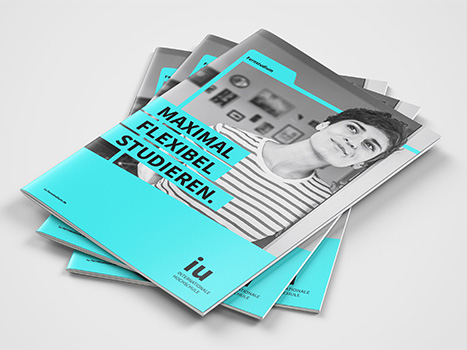

Distance learning & online studies: Study entrepreneurship part-time
Currently, there are only three private universities that offer entrepreneurship as an online or distance learning programme. The advantage of distance learning courses: You can study from home and, due to the flexibility, you can also study while working.
I will briefly present all three programmes here.
B.A. Entrepreneurship at the IU International University of Applied Sciences
The Bachelor in Entrepreneurship at IU is currently the only Bachelor distance learning programme in Entrepreneurship at a German university. The full-time programme lasts 6 semesters, but can be extended to 12 semesters of part-time study. A university entrance qualification is required, but admission is also possible without an Abitur for those with vocational training and 3 years of relevant work experience.
The exemplary study structure for full-time study is as follows:
- Semester 1: Marketing, Introduction to User Research, Introduction to Scientific Work, Project: Development of Business Ideas, Applied Sales I, Law
- Semester 2: Start-up Financing, Bookkeeping and Accounting, Agile Project Management, Applied Sales II, Collaborative Working, Project: Prototyping and Validation of a Business Idea
- Semester 3: Cost and performance accounting, economics and the market, pricing policy, corporate planning and control, intercultural and ethical action skills, project: setting up a company
- Semester 4: Market Research, Fundamentals of Product Management, International Brand Management, Personnel Psychology, Agile Management, Project: Business Model Development
- Semester 5: Project: Minimum Viable Product, Seminar: Current Topics in Digitalisation, Online Marketing, Organizational Behaviour, Elective Subject A
- Semester 6: Elective subject B, elective subject C, Bachelor thesis
In the last semester, you choose your two electives from this pool of modules: Social Entrepreneurship, User Testing and Prototyping, Business Ethics and Sustainability, Organisational Development and Change Management, Digital Entrepreneurship, Intrapreneurship, Sustainable Entrepreneurship.
The amount of the tuition fees depends on which study model you choose. In the full-time programme, you pay 359 euros per month, a total of 12,924 euros. In part-time study I, you pay 309 euros per month, for a total of 14,834 euros. In part-time study II, you pay 209 euros per month, for a total of 15,048 euros.
M.A. Entrepreneurship at SRH Fernhochschule - The Mobile University
 The Master's programme Entpreneurship at SRH is the only distance learning Master's programme in entrepreneurship at a private university in Germany besides the MBA at AKAD University of Applied Sciences. The Master's programme lasts 4 semesters in full-time study, but can be extended to 8 semesters. A university degree or equivalent and 1 year of professional experience are required.
The study structure as follows:
- Semester 1: Empirical Research & Strategic Digital Communication for Founders, Application Project Founding - Part I, Entrepreneurship in Digital Times, Project and Change Management
- Semester 2: Application Project Foundation - Part II, Digital Strategies and Business Models, Financial Economics and Business Decisions, Empirical Market Research, Leadership
- Semester 3: Application Project Foundation - Part III, four elective modules
- Semester 4: Scientific thesis and colloquium
In the 3rd semester you choose 3 of these elective modules: Digital Sales & Marketing, Business Intelligence & Analytics, Design Thinking & Innovation, Controlling, Corporate Governance, Culture & Ethics, Data Analysis, Industry 4.0 and Production in the Digital World, Market and Advertising Psychology, Personnel Psychology, Public Relations: Opportunities and Perspectives, Strategic Management, Human Resources and Organisation, Values and Conflict.
The total tuition fees are 12,936 euros, payable in monthly contributions of 539 euros.
MBA Entrepreneurship and Innovation at AKAD University of Applied Sciences
The Master of Business Administration Entrepreneurship and Innovation is the only MBA distance learning programme in Entrepreneurship at a private university in Germany. The programme takes 4 semesters of full-time study, but can be shortened to up to 12 months for those who already have a diploma, such as a degree in business administration. The distance learning programme can be extended to up to 8 semesters of part-time study. A first university degree and 1 year of relevant professional experience are required.
The study structure is as follows:
- Semester 1: Key qualifications for study and work, tax and business law, investment and financing, entrepreneurial marketing, project and quality management, leadership in change processes.
- Semester 2: Innovation Management, Technology Management, Research and Development Management, Business Ethics and Value Management, Corporate Governance, Capstone Start-up Management/Corporate Entrepreneurship
- Semester 3: Business game General Management, case study work, elective module
- Semester 4: Master thesis
As an elective module, you choose from these topics: Business Model Development, International Innovation Management, Electronic Entrepreneurship, Entrepreneurial Finance, Intellectual Property Rights and Technology Law.
The tuition fees for full-time study are 13,560 euros in total, 565 euros per month. The part-time 6-semester programme costs a total of 14,040 euros, 390 euros per month. In the part-time programme 8 semesters you pay a total of 15,024 euros, 313 euros per month.


Entrepreneurship from Hamburg to Munich: Which study city is the best
Bachelor's and Master's degrees in Entrepreneurship are offered at private universities in many cities in Germany. Some universities, such as the Fresenius University of Applied Sciences, even offer their courses at several locations.
Here is an overview of the most interesting study cities for Bachelor's and Master's degrees in Entrepreneurship:
| City | Cost of living | Quality of life | Population density | Universities |
|---|---|---|---|---|
| Munich | 66.53 | 176.16 | 4,736 | Fresenius University of Applied Sciences, Hochschule der Bayerischen Wirtschaft, University of Applied Management, Munich Business School |
| Hamburg | 56.32 | 162.48 | 2,447 | Fresenius University of Applied Sciences |
| Berlin | 54.18 | 160.49 | 4,115 | Fresenius University of Applied Sciences, SRH Berlin University of Applied Sciences, Business School Berlin |
| Cologne | 52.94 | 158.48 | 2,686 | CBS International Business School, International School of Management |
| Dusseldorf | 52.61 | 175.02 | 2,860 | Fresenius University of Applied Sciences |
Business studies as an alternative to entrepreneurship studies
Although there are currently only two bachelor's degrees in entrepreneurship at private universities, the range of business administration and management programmes is enormous. I recommend that high school graduates in particular study business administration or economics. In most degree programmes, you can then focus on entrepreneurship or entrepreneurship, for example through elective modules or the final thesis.
Here is an overview of interesting business programmes at private business schools:
| Course | University | Study site | Duration | Fees | |
|---|---|---|---|---|---|
| Business Administration, Bachelor of Science On-campus program | Frankfurt School of Finance and Management | Frankfurt am Main | 7 Semester | from 46800 € total | |
| Business Administration, Bachelor of Arts On-campus program | Fresenius University of Applied Sciences | Dusseldorf, Heidelberg, Hamburg, Cologne, Munich or Wiesbaden | 6 Semester | from 30600 € total from 850 € monthly | |
| Business Administration, Bachelor of Science On-campus program | BSP Business and Law School | Berlin | 6 Semester | from 21240 € total from 590 € monthly | |
| Business Administration, Bachelor of Arts On-campus program | Northern Business School | Hamburg | 7 Semester | from 20670 € total from 485 € monthly | |
| General Management, Bachelor of Science On-campus program | EBS University of Business and Law | Wiesbaden | 6 Semester | from 46020 € total from 1223 € monthly | |
| Management, Bachelor of Arts On-campus program | Macromedia University of Applied Sciences | Berlin, Frankfurt, Freiburg, Hamburg, Cologne, Leipzig, Munich, Stuttgart | 7 Semester | from 26100 € total from 725 € monthly | |
| Management, Philosophy and Economics, Bachelor of Science On-campus program | Frankfurt School of Finance and Management | Frankfurt am Main | 7 Semester | from 46800 € total |
You can find more study programmes here: Study business administration: all universities, all business schools, all degree programs

About the Author Christian Wolf
 This provider offers free info materials to download or send. Would you like to be redirected to the provider's website? There you will find much more information about the course.
Study Advice
Questions about the topic? Use our study advisory service, we are happy to help.
or post as a guest